Deep Blue Deploys Drone, Armoured Vehicle To Strengthen Maritime Security
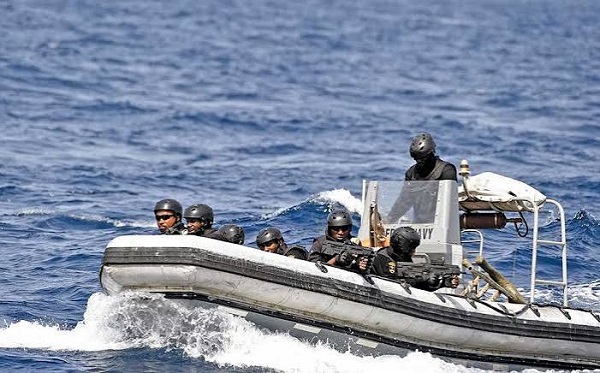
The Deep Blue Project has deployed new surveillance technology, including a drone and an armoured vehicle, to strengthen maritime security, combat illegal activities in Nigerian waters and protect government revenue.
The new equipment was unveiled by the Chief Executive Officer of HLS International, Tal Spektor, at the Africa International Defence Exhibition (AFRIDEX) in Eko Atlantic City, Lagos.
HLS International provides technical support to the Nigerian Maritime Administration and Safety Agency (NIMASA) under the Deep Blue Project, which coordinates civilian maritime authorities and security agencies under the Federal Ministry of Marine and Blue Economy, in collaboration with the Ministry of Defence.
Other equipment showcased at the exhibition included a vertical take-off and landing (VTOL) unmanned aerial vehicle, a light utility vehicle and tactical equipment for special forces.
The VTOL drone is designed to conduct surveillance operations from vessels at sea and from land, with capabilities for both daytime and nighttime missions. The armoured vehicle is expected to support special forces operating in different security environments.
Speaking at the unveiling, Spektor said the upgrades would enhance intelligence gathering, improve the monitoring of suspicious vessel movements and strengthen enforcement of maritime regulations.
He explained that the project’s surveillance infrastructure could track vessels approaching Nigeria’s Exclusive Economic Zone (EEZ) using information such as ownership records, International Maritime Organisation (IMO) identification numbers and Automatic Identification System (AIS) transmissions.
According to him, vessels that stop transmitting AIS signals could be flagged for further investigation, although the absence of a signal alone does not establish wrongdoing.
Spektor said the project had also enhanced its Command, Control, Communications, Computers and Intelligence (C4I) system to provide historical information about vessels and intelligence on cargo movements.
He noted that the platform could access up to 15 years of vessel history, while recent integrations had expanded its ability to monitor dry cargo and other shipping activities relevant to NIMASA and other government agencies.
He said the improved intelligence capabilities would help authorities identify potential regulatory violations, monitor activities within Nigerian waters and strengthen efforts to prevent revenue losses.
Beyond combating piracy, militancy and arms trafficking, Spektor said the project was also focused on addressing illegal fishing and environmental offences that threaten coastal communities and marine resources.
He warned that illegal fishing could deprive legitimate operators of income, while the unauthorised discharge of hazardous waste into the sea could endanger marine life and public health.
According to him, the impact of maritime insecurity extends beyond the sea, affecting the livelihoods, health and economic well-being of ordinary Nigerians.
Spektor stressed that continuous investment in modern technology was necessary to keep pace with evolving security threats and improve the country’s ability to enforce maritime laws.
He also attributed Nigeria’s recent international maritime milestones to cooperation among NIMASA, the Ministry of Marine and Blue Economy, the Ministry of Defence and other security agencies.
Among the developments he highlighted were Nigeria’s election into Category C of the IMO Council and the lifting of a United States restriction relating to Nigerian ports after 12 years. He also referred to Nigeria’s removal from international maritime blacklists and red lists but did not specify the particular listings during the presentation.
The AFRIDEX event featured a demonstration of the tactical and operational capabilities of the Deep Blue Project’s special forces.
Spektor reaffirmed HLS International’s commitment to supporting Nigeria’s maritime security through technology deployment, training and operational assistance, expressing confidence that the upgraded capabilities would improve surveillance, law enforcement and the protection of the country’s maritime resources.