Digital Transformation: How Instanta Technology Could Reshape Nigeria’s Haulage, Freight Industry
OLORUNDARE ENIMOLA, Lagos
Nigeria’s haulage and freight industry remains the backbone of the nation’s supply chain network, supporting the movement of petroleum products, agricultural commodities, manufactured goods, construction materials and other essential cargo across the country.
However, despite its strategic importance, the sector continues to struggle with operational inefficiencies, fragmented systems, rising costs, insecurity, poor visibility of cargo movement, manual processes and limited adoption of modern technology.
As global logistics continues to embrace automation, artificial intelligence (AI), Internet of Things (IoT), digital payments, predictive analytics and real-time tracking, Nigeria’s haulage industry is at a critical point where technology adoption is no longer a luxury but a necessity for competitiveness and survival.
The unveiling of new digital solutions by Sysserve Solutions Limited, the technology company behind the Instanta fleet management platform, highlights the growing opportunity for technology-driven transformation in Nigeria’s logistics ecosystem.
The solution provides Journey Map, Bank Payments and Tyre Hive in an attempt to address some of the most persistent challenges affecting haulage operators, particularly in the oil and gas logistics sector.
The Challenges of Nigeria’s Haulage Industry
For decades, many Nigerian haulage companies have relied heavily on traditional operational methods involving paperwork, telephone communication, spreadsheets and disconnected tracking systems.
While some large operators have adopted basic fleet monitoring technologies such as GPS tracking, many companies still lack fully integrated digital platforms that provide end-to-end visibility of their operations.
One major challenge is the absence of real-time cargo visibility. Many fleet operators know the location of their trucks through GPS devices, but they often lack information about the entire journey process, whether a vehicle is carrying the right cargo, whether it is following the approved route, whether it will arrive on schedule, and whether proof of delivery has been completed.
This fragmented approach creates room for delays, fuel theft, route deviation, inefficient vehicle utilisation and disputes between transporters, customers and drivers.
Another major challenge is manual payment processing. Driver allowances, vendor payments and operational expenses often pass through several approval stages, leading to delays, administrative burdens and reduced efficiency.
Maintenance management is also a serious concern. Without accurate digital records, fleet owners struggle to determine when vehicles require servicing, monitor spare parts usage or prevent unnecessary downtime.
Tyre management remains another expensive challenge. Tyres are among the most costly consumables in fleet operations, yet many companies lack effective systems to monitor tyre history, usage patterns and replacement cycles. This creates opportunities for losses, mismanagement and safety risks.
How Technology Can Transform Haulage Operations
Globally, leading logistics markets have moved beyond basic vehicle tracking into intelligent fleet management systems that combine data analytics, automation and artificial intelligence.
Modern logistics companies use technology to optimise routes, predict maintenance needs, reduce fuel consumption, automate payments, monitor driver behaviour and provide customers with real-time delivery information.
For Nigeria, technology adoption could significantly improve productivity and reduce operational costs.
A digitally connected haulage system can help operators:
- reduce empty truck movements;
- improve delivery efficiency;
- reduce fuel losses;
- enhance driver accountability;
- improve road safety;
- provide customers with transparent cargo tracking;
- reduce paperwork;
- support faster decision-making through accurate data.
Technology can also improve Nigeria’s competitiveness in regional trade by making freight operations more reliable and predictable.
Has Nigeria Fully Integrated Technology Into Haulage?
Although some major logistics companies, especially those operating in the oil and gas, manufacturing and FMCG sectors, have introduced digital solutions, the Nigerian haulage industry has not yet achieved full automation.
The industry remains largely characterised by partial adoption. Many companies use isolated technologies—GPS tracking, accounting software or transport management systems—but these solutions often operate independently.
This creates a major gap because logistics operations involve multiple interconnected activities, including order management, dispatch, vehicle monitoring, driver payments, customer communication, maintenance and reporting.
Without integration, companies still depend heavily on manual intervention.
The challenge is not the absence of technology but the lack of comprehensive platforms capable of connecting all aspects of freight operations into one ecosystem.
Instanta: Addressing the Missing Link
According to Johnson Owoeye, Co-founder and Chief Operating Officer of Sysserve Solutions Limited, the development of Instanta was inspired by the need for a complete digital operating system for logistics companies.
He explained that an earlier interaction with the managing director of a major logistics company revealed the industry’s real demand: not just vehicle tracking, but a complete system capable of planning journeys, calculating operational costs, automating fuel management, processing driver payments, monitoring routes, managing proof of delivery and integrating with accounting systems.
That vision has now evolved into the Instanta platform.
Unlike conventional GPS solutions that only show vehicle location, Instanta seeks to provide a complete operational picture.
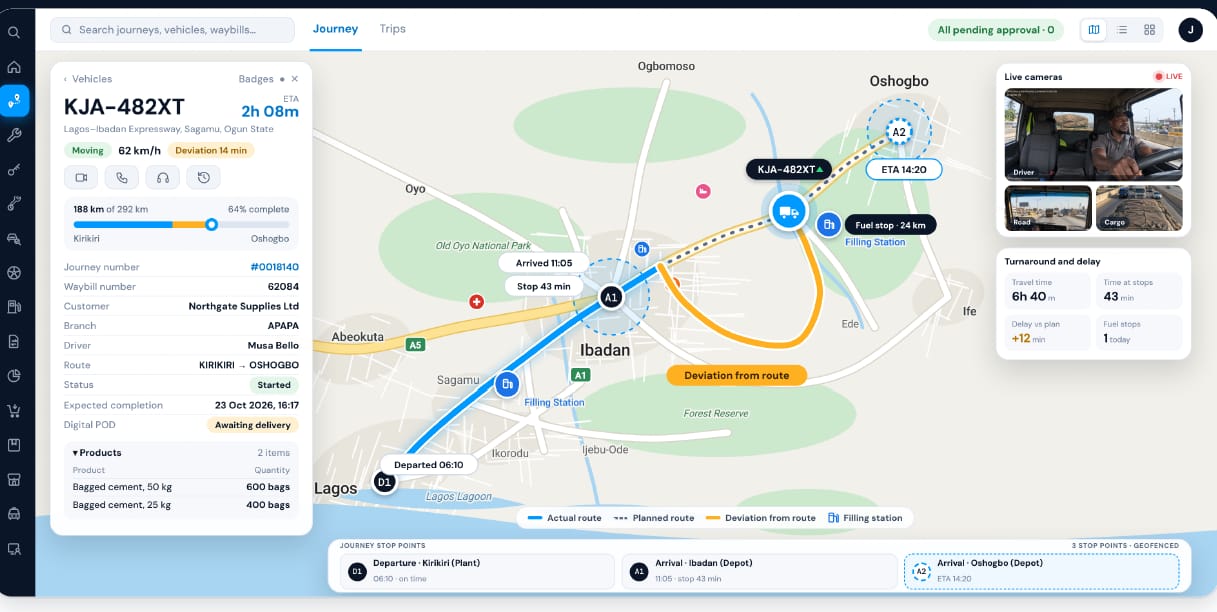
Its Journey Map solution combines logistics planning, vehicle movement, customer information, delivery schedules, proof of delivery and route monitoring on one platform.
This could significantly improve transparency between transport companies and their customers.
A customer waiting for a delivery would no longer need to repeatedly contact a logistics company to ask about the location of cargo. Through a digital link, customers can monitor delivery progress in real time through mobile devices or web platforms.
For fleet operators, this means improved customer confidence and fewer disputes.
Automation of Payments and Financial Control
The Bank Payments solution addresses another critical challenge in operational payments.
Driver payment delays have historically affected relationships between transport companies and drivers. By integrating banking platforms into logistics operations, Instanta enables automated payment processing once journeys are approved.
This could reduce administrative workload, improve driver satisfaction and increase operational efficiency.
The same system can also support payments to vendors, technicians and other service providers, creating a more transparent financial management structure.
Tyre Management Through Digital Identification
The Tyre Hive solution, powered by RFID technology, addresses one of the most overlooked areas of fleet management.
By assigning a unique digital identity to every tyre, operators can monitor tyre history, mileage, installation records and replacement cycles.
This provides better control over one of the biggest operating expenses in haulage.
It can also reduce fraud and misuse by ensuring that every tyre attached to a vehicle is properly recorded and traceable.
For technology to deliver maximum impact, Nigerian haulage companies must move beyond viewing digital solutions as optional investments.
Operators need to embrace technology as a strategic tool for survival and growth.
This requires investment in staff training, improved digital literacy, stronger collaboration between transport associations and technology providers, and government policies that encourage innovation.
Small and medium-sized operators, who make up a significant portion of Nigeria’s freight sector, should also be encouraged to adopt scalable digital solutions that match their operational capacity.
The future of Nigeria’s haulage industry will depend heavily on how quickly operators embrace technology-driven transformation.
While challenges such as poor infrastructure, insecurity and high operational costs remain, digital solutions can help companies operate more efficiently, transparently and competitively.
Instanta by Sysserve Solutions represents an important step toward solving some of the industry’s long-standing problems by integrating journey management, payments, monitoring, maintenance and operational intelligence into a single platform.
If widely adopted, solutions such as Instanta could help reposition Nigeria’s haulage sector from a largely manual and fragmented industry into a modern, data-driven logistics ecosystem capable of competing with global standards.
The transformation may not happen overnight, but the direction is clear: the future of freight belongs to operators who successfully combine human expertise with digital intelligence.