


FG Inaugurates Committee To Drive Sustainable Aviation Fuel Programme
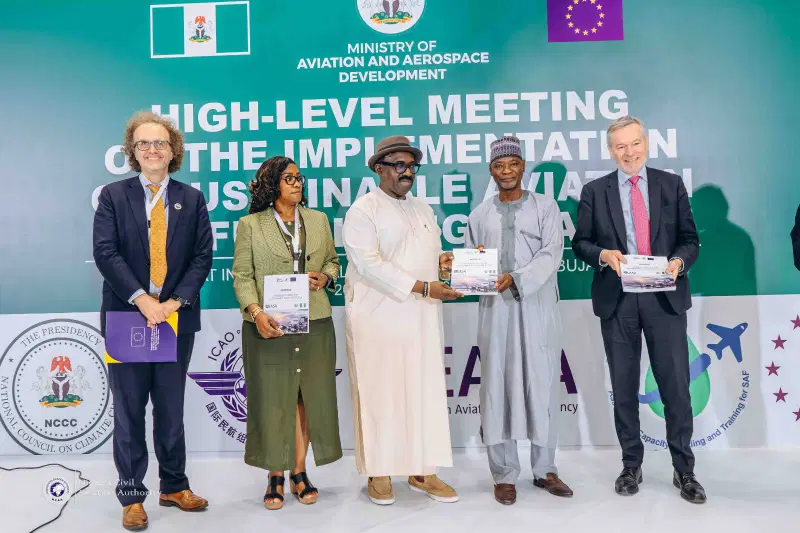
The Federal Government has inaugurated a seven-member National High-Level Sustainable Aviation Fuel (SAF) Steering Committee to coordinate the implementation of Nigeria’s Sustainable Aviation Fuel Programme and accelerate the decarbonisation of the country’s aviation sector.
The committee comprises the Minister of Aviation and Aerospace Development, Minister of Innovation, Science and Technology, Minister of Agriculture and Food Security, Minister of State for Petroleum Resources, Director-General of the Nigerian Civil Aviation Authority (NCAA), Director-General of the National Council on Climate Change, and the Managing Director of NNPC New Energy Limited.
The inauguration took place on Monday during a high-level meeting on Sustainable Aviation Fuel implementation in Abuja, where the Minister of Aviation and Aerospace Development, Festus Keyamo, also unveiled Nigeria’s National Sustainable Aviation Fuel Feasibility Study and launched the Sustainable Aviation Fuel Business Implementation Study with support from the International Civil Aviation Organisation (ICAO).
The event, organised by the NCAA in collaboration with ICAO, the European Union (EU) and the European Union Aviation Safety Agency (EASA), brought together government officials, development partners, industry stakeholders and researchers to advance Nigeria’s transition to cleaner aviation fuel.
Represented by the Director of Air Transport Management, Alhaji Mohammad Tijani, Keyamo said the steering committee would provide strategic direction, coordinate implementation, promote collaboration among stakeholders and oversee the execution of the national SAF implementation programme.
He stressed that the transition to sustainable aviation fuel requires collaboration among government institutions, the private sector, academia, financial institutions and development partners, noting that the aviation sector must contribute to global efforts to reduce greenhouse gas emissions while supporting economic growth.
According to the minister, the development of a sustainable aviation fuel industry presents opportunities to attract investment, create jobs, strengthen energy security and unlock value across Nigeria’s agricultural, energy and industrial sectors.
He added that Nigeria’s abundant feedstock resources, including cassava and agricultural residues, position the country to become a leading producer and supplier of sustainable aviation fuel in Africa.
Speaking on the feasibility study, Keyamo described it as a technical assessment of Nigeria’s opportunities and challenges, noting that it would serve as the foundation for implementing the national programme. He added that the Business Implementation Study would provide commercial and investment analysis aimed at attracting local and international investors.
The minister reaffirmed the Federal Government’s commitment to providing the necessary policy direction, regulatory framework and investment incentives to support the emerging sustainable aviation fuel industry.
He also reiterated Nigeria’s commitment to implementing the Carbon Offsetting and Reduction Scheme for International Aviation (CORSIA) and other global climate initiatives while pursuing the country’s climate and sustainable development goals.
The Director-General of the NCAA, Capt. Chris Najomo, said the feasibility study was developed under ICAO’s Assistance, Capacity-building and Training for Sustainable Aviation Fuels (ACT-SAF) Programme with financial support from the European Union and technical support from EASA.
Najomo explained that the study provides an evidence-based roadmap for converting Nigeria’s feedstock resources into commercially viable sustainable aviation fuel production. He also reaffirmed the NCAA’s commitment to coordinating stakeholders as the secretariat of the steering committee.
Goodwill messages were delivered by representatives of ICAO, the European Union, the Ministries of Innovation, Science and Technology, Agriculture and Food Security, Petroleum Resources, the National Council on Climate Change, and NNPC New Energy Limited.
Speakers emphasised the importance of collaboration among government agencies, development partners and the private sector in developing a sustainable aviation fuel industry in Nigeria.
The meeting concluded with renewed commitments by the Federal Government and its international partners to fast-track the implementation of the Sustainable Aviation Fuel Programme and position Nigeria as a regional hub for sustainable aviation fuel production.

