


PRNigeria Fellows Commend FRSC Reforms, Call For Stronger Road Safety Communication
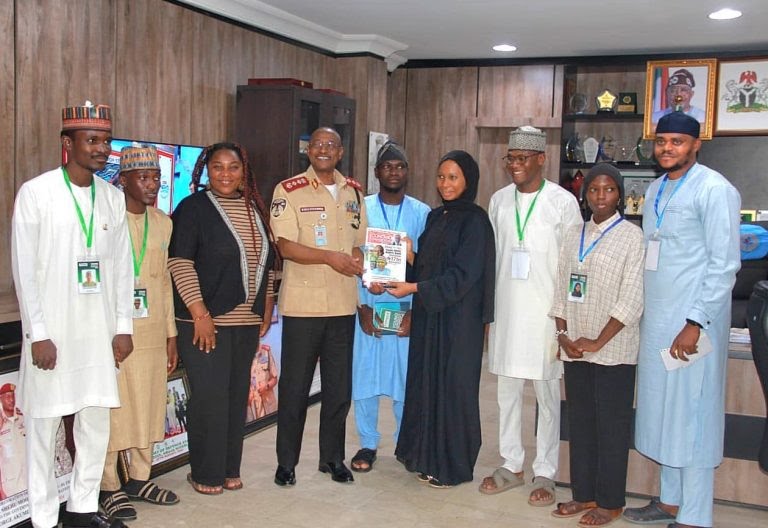
Members of the PRNigeria Young Communication Fellowship (PYCF) have commended the Federal Road Safety Corps (FRSC) for reforms they said have improved operational efficiency, embraced digital technology and strengthened the agency’s citizen-focused approach.
The fellows made the commendation during a courtesy visit and facility tour of the FRSC headquarters in Abuja, where they engaged the Corps Marshal, Shehu Mohammed, on road safety, strategic communication and behavioural change.
Led by Samira Mohammed and Chilakpu Zoe Chinemeremebere, the delegation said the FRSC had recorded significant progress under Mohammed’s leadership, particularly through policy innovation, digital transformation and improved personnel welfare.
They cited the introduction of a paperless electronic document management system, deployment of body cameras for patrol officers and expansion of rescue services as reforms that have enhanced the agency’s operations and emergency response on Nigerian highways.
The fellows also called for stronger and more sustained public communication on road safety, noting that effective communication was critical to changing risky behaviours among road users.
They further commended the FRSC for receiving recognition in the Public Affairs category at the 2026 National Spokespersons Awards, describing the award as an acknowledgement of the agency’s communication and institutional reforms.
Responding, Mohammed disclosed that nearly 5,000 Nigerians die annually in road traffic crashes, with about 80 per cent of the victims below the age of 30.
He therefore called for greater emphasis on prevention, public education and behavioural change, stressing that enforcement alone could not address the country’s road safety challenges.
According to him, social and economic factors, including poverty, low literacy and limited access to affordable transportation, often influence risky behaviour among road users.
Mohammed cited the practice of passengers travelling on top of trucks carrying goods because such transportation is cheaper than conventional means as an example of how economic hardship can contribute to road safety violations.
The Corps Marshal also condemned the practice of conveying people, animals and goods in the same vehicles, describing it as a major safety challenge requiring sustained public enlightenment and effective enforcement.
He linked road safety to national security and identified rail transportation as a safer alternative to road travel. However, he expressed concern over the vandalism of railway infrastructure, saying it undermines public investment and efforts to reduce pressure on the nation’s highways.
Mohammed urged journalists, researchers and communication professionals to look beyond reporting road crashes and investigate the underlying factors responsible for them.
“Go to the grassroots to know what’s actually happening,” he advised the fellows, urging them to promote evidence-based interventions that could help reduce road fatalities.
The visit was part of the official study tours of the annual PRNigeria Young Communication Fellowship, which exposes participants to practical approaches to strategic communication, public behaviour change and institutional reputation management.
The fellowship, launched in 2024 by Image Merchants Promotion Limited, publishers of PRNigeria, Economic Confidential and Spokespersons Digest, is a fully funded two-week residential programme designed to train young Nigerians in journalism, public relations and strategic communication.
Thirty participants from Abuja, Ilorin and Kano are selected annually for training in areas including news writing, multimedia storytelling, public relations, crisis communication, fact-checking, media law, public speaking and the use of artificial intelligence in journalism.
The 2026 edition attracted 691 applications and is endorsed by the Nigeria Union of Journalists, Nigerian Institute of Public Relations, Wole Soyinka Centre for Investigative Journalism and Centre for Crisis Communication.
