

Tinubu Commissions Opebi-Mende-Ojota Link Bridge To Ease Lagos Traffic
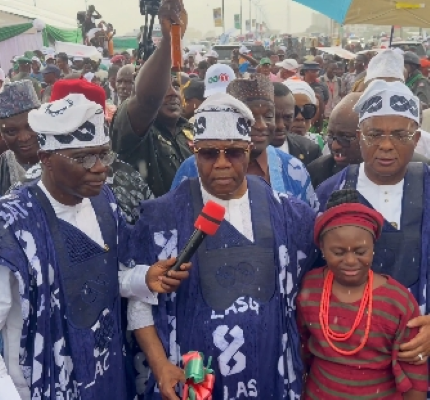
President Bola Ahmed Tinubu has commissioned the Opebi–Mende–Ojota Link Bridge in Lagos, reinforcing ongoing efforts to tackle traffic congestion and improve urban mobility in Nigeria’s commercial capital.
The President, who was represented at the event by Senate President Godswill Akpabio, described the project as a strategic intervention aimed at easing movement across some of the city’s busiest corridors. The inauguration attracted top government officials, transport stakeholders, and residents who gathered to witness the opening of the long-anticipated infrastructure.
Delivered under the THEMES+ development agenda of the Lagos State Government, the bridge was constructed by Julius Berger Nigeria Plc, a firm widely known for handling major engineering projects across the country. The project reportedly cost several billions of naira, reflecting both its scale and significance within the state’s expanding road network.
Construction began during the administration of Governor Babajide Sanwo-Olu and was completed within an accelerated timeframe of approximately 18 to 24 months. The speedy delivery underscores the government’s commitment to fast-tracking critical infrastructure projects to meet the demands of a rapidly growing population.
Strategically designed, the Opebi–Mende–Ojota Link Bridge connects key residential and commercial areas including Opebi, Mende, and Ojota. It also provides alternative routes for motorists navigating traffic-prone zones such as Toyin Street and Allen Avenue, linking them seamlessly to Maryland, Ikeja, and adjoining districts.
Urban planners and government officials say the new corridor is expected to significantly reduce travel time for commuters, decongest overstretched roads, and improve traffic flow across the metropolis. For many residents and businesses in the affected areas, the bridge offers long-awaited relief from daily gridlock, which has historically slowed economic activity and increased commuting stress.
Speaking at the ceremony, officials highlighted the broader economic impact of the project, noting that improved road connectivity will facilitate faster movement of goods and services. This, in turn, is expected to enhance productivity and support business growth across key commercial hubs in the state.
The bridge also aligns with Lagos State’s wider vision of building a modern, efficient, and globally competitive megacity. Authorities emphasized that sustained investment in transport infrastructure remains central to achieving this goal, particularly as the state continues to experience rapid urbanisation and population growth.
The commissioning forms part of a larger infrastructure expansion drive that has seen the delivery of several landmark projects in recent years. These include the Lekki Deep Sea Port, as well as the Blue and Red Lines of the Lagos Rail Mass Transit system, all aimed at transforming mobility and strengthening economic resilience.
Residents and commuters have expressed optimism that the new bridge will bring lasting relief to one of Lagos’ most congested traffic corridors, while also setting the pace for future infrastructure development across the state.
