Tinubu’s Legacy Road Projects To Connect All Six Geopolitical Zones — Umahi
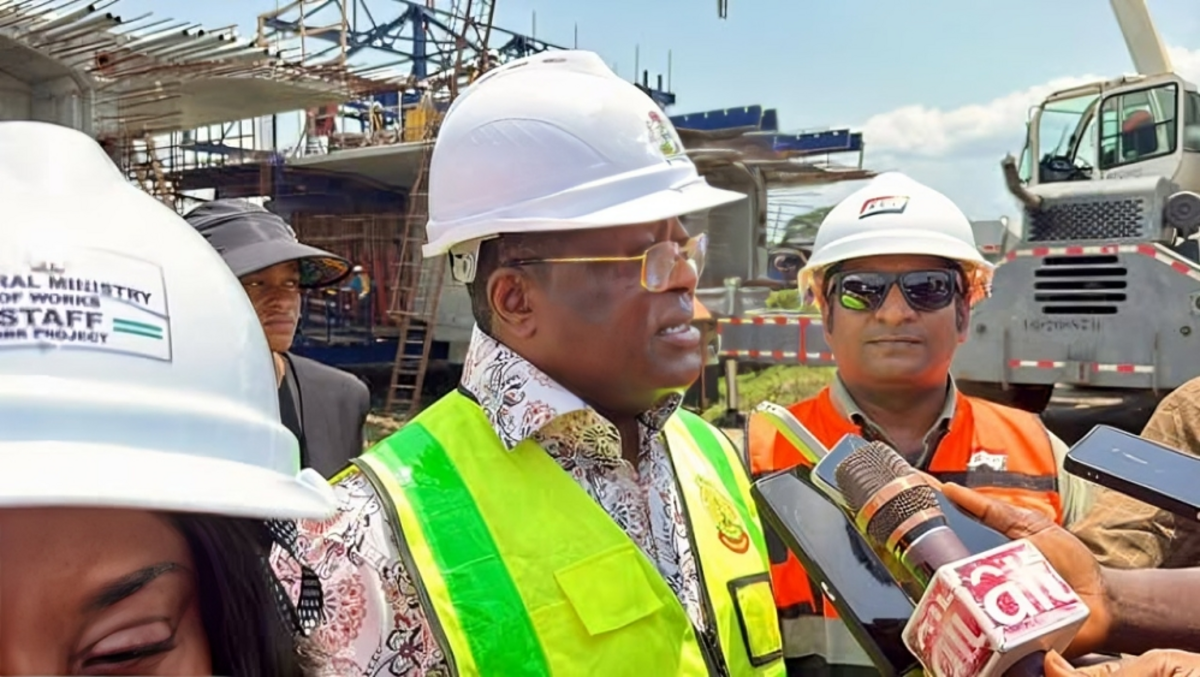
Minister of Works, Senator David Umahi, has said that President Bola Tinubu’s four flagship road infrastructure projects are designed to link Nigeria’s six geopolitical zones through an integrated transport network aimed at enhancing economic growth, food security and regional development.
Umahi made the disclosure in Abuja while receiving a delegation from the ECOWAS Bank for Investment and Development (EBID), led by Mrs. Maimouna Sidibe, Head of the Basic Infrastructure Division, Department of Public Sector Corporations. The delegation is conducting appraisal activities ahead of the approval of financing for Section One of the Trans-Sahara Super Highway.
According to the minister, the four legacy road projects initiated by President Bola Tinubu were strategically conceived as an interconnected transportation loop that would improve connectivity across the country.
“The entire four legacy projects of Mr President are interconnected in a loop,” Umahi said.
He explained that the 750-kilometre Lagos-Calabar Coastal Highway is linked to the Trans-Sahara Super Highway through Ndibe Beach in Cross River State, creating a seamless transport corridor across several regions.
Umahi disclosed that Section One of the Trans-Sahara Super Highway spans 123.64 kilometres from Ndibe Beach to the Benue State border, while additional sections covering Benue, Kogi and Nasarawa states have already been awarded.
Describing the route as a major agricultural and trade corridor, the minister said the highway would strengthen food distribution networks and support national food security efforts.
“It has long existed and remains a major food corridor. It is critical to food sufficiency in our country,” he stated.
He added that the project would connect key agricultural hubs in Cross River, Ebonyi and Benue states while reducing travel time between Calabar and Abuja to approximately four hours.
The minister also revealed plans to leverage existing dams along the corridor for irrigation and renewable energy projects, noting that the development would attract investments, create jobs and stimulate industrial growth.
“There are many benefits to this project. Beyond tolling and corridor development for investment returns, it will generate numerous jobs, both direct and indirect,” Umahi said.
He further explained that the Trans-Sahara Super Highway would connect with another legacy project through the Abuja-Akwanga corridor, extending to Jos, Bauchi, Gombe, Biu and Maiduguri.
According to him, the recently inaugurated Gombe-Biu section covers 125 kilometres and is being developed as a six-lane carriageway, while procurement processes for the Bauchi-Gombe section are ongoing.
Umahi also outlined plans to link the Lagos-Calabar Coastal Highway with the Sokoto-Badagry Super Highway through a new alignment beginning from Victoria Island and extending through a 3.5-kilometre tunnel, Ogogoro Island and Snake Island before reaching Badagry.
“When you look at all of this on a map, you see a loop. All the geopolitical zones are included. If you start from Sokoto, you can access all six geopolitical zones within two days,” he said.
The minister commended the contractor handling Section One of the Trans-Sahara Super Highway, noting that construction progress had exceeded 20 per cent. He stressed the need to fast-track loan approvals to sustain ongoing works.
“My concern is that we need to fast-track the loan component because once they reach 30 per cent completion, payments will become necessary,” he added.
Earlier, Mrs. Sidibe reaffirmed EBID’s commitment to financing the project, describing it as a priority infrastructure investment for the region.
She disclosed that the project had already received favourable consideration from the bank’s first credit committee and had advanced to the appraisal stage.
According to her, the delegation’s visit includes consultations with relevant government agencies and site inspections to assess project implementation, environmental compliance and social safeguards.
Sidibe said the project is expected to move to the second credit committee next week before being presented to the Board of Executive Directors in early July for final approval.
She also commended the Federal Government for fulfilling its counterpart funding obligations, noting that 30 per cent of the required funding had already been provided.
Expressing satisfaction with the quality of work on the project, Sidibe praised the construction technology being deployed, stating that the road is expected to have a lifespan of at least 50 years.
“The members of the credit committees said that this technology is very good and already experienced on the Lagos-Calabar project, and the road lifespan will be at least 50 years,” she said.