FG Dismisses Rumour Of First Niger Bridge Demarcation Demolition
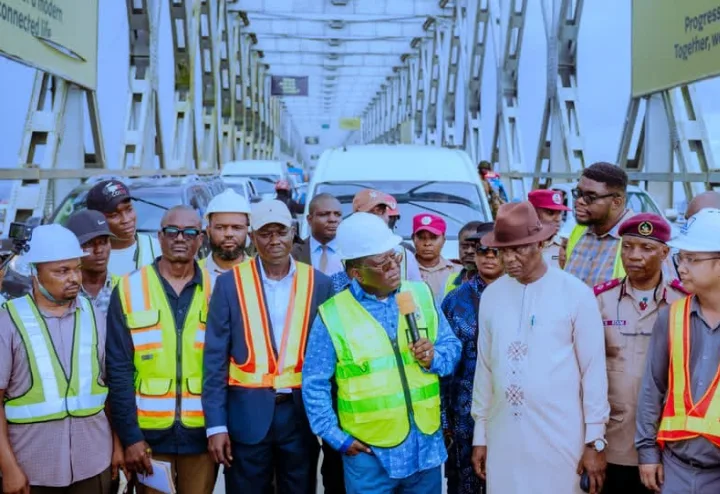
The Federal Government has dismissed reports that the newly installed demarcation on the First Niger Bridge linking Onitsha, Anambra State, and Asaba, Delta State, has been demolished.
The Federal Controller of Works, Anambra State Field Headquarters, Timothy Emenike, clarified on Wednesday that the demarcation remained intact, explaining that the ministry only created openings at strategic points to facilitate emergency U-turns and allow security and emergency agencies to operate effectively on the bridge.
Emenike spoke while addressing journalists who inspected the bridge amid reports circulating on social media that the demarcation had been removed.
He described the reports as misleading and urged members of the public to disregard them.
“The demarcation was not destroyed. The Ministry only created some openings around the demarcation to enable vehicles make U-turn in case of emergency and also to allow the FRSC, fire service and other traffic agencies carry out emergency duties whenever the need arises on the bridge,” he said.
According to him, the openings were necessary to ensure that emergency responders could access and operate on the bridge whenever required.
The clarification followed public concerns over the controversial demarcation introduced during the rehabilitation of the bridge, with some motorists and residents expressing fears that the reduced carriageway space could worsen traffic congestion and hinder emergency operations.
The First Niger Bridge was temporarily closed to traffic from September 7 to 21 for emergency rehabilitation and maintenance after vandalised structural components, including parts of its expansion-joint steelwork, were discovered.
The closure was subsequently extended by one week due to persistent rainfall and other unforeseen circumstances.
Emenike said the major construction works on the bridge had now been completed, including road surfacing, asphalt laying, installation of expansion bolts and repairs to other critical components.
He added that painting of the bridge railings had commenced, while bolts for the lighting poles were also being fixed.
“Barring no unforeseen circumstances, the bridge may likely be reopened before the end of this week since all construction works have been completed,” he said.
A visit to the bridge by journalists on Wednesday confirmed that painting works were ongoing, alongside the installation of bolts around spaces created within the demarcation for electric poles.
Some pedestrians who spoke during the inspection expressed satisfaction with the progress of work and said they looked forward to the reopening of the bridge, which they said would ease the difficulties faced by commuters.
A pedestrian, John Uche, urged the government to consider restricting articulated and heavy-duty vehicles from using the First Niger Bridge and directing them to the Second Niger Bridge.
He said the measure would improve traffic flow, reduce obstruction and help preserve the ageing bridge.
Uche also called for remedial works on the route from Upper Iweka Interchange through Owerri Road to Obosi Interchange to facilitate the smooth movement of heavy-duty vehicles.
Meanwhile, the Onitsha branch of the Nigerian Society of Engineers commended President Bola Tinubu for the emergency rehabilitation of the bridge, describing the intervention as a significant infrastructure milestone.
The engineers also called on the Anambra and Delta State governments, in collaboration with the Federal Government, to establish fully equipped 24-hour emergency and safety response centres on both approaches to the bridge.
They recommended that the centres should have Federal Road Safety Corps rescue teams, ambulances with paramedics and first-aid equipment, fire trucks and rescue equipment, as well as security patrol teams.